

We, Shenzhen Sinelink Electronics co., limited, are a professional provider of a comprehensive range of medical accessories and solutions for customers tailored to meet their specific needs, we have the capability and flexibility of manufacturing in both high and low volumes, we delivery qualified products with more cost-effective.
Sinelink is your one-stop-shop for all patient monitor accessories, we are specialized and experts in this field which has allowed us to supply qualify products, all our products are designed and manufactured to the specifications of the original equipment manufacturer's products, characteristics are meeting or exceeding the original manufacturer's warranty.

Why Choose Us
01
Technical Support
We have a professional technical support team, ready to answer your technical questions during product use. No matter what difficulties you encounter, just contact us and we will be happy to provide you with a solution.
02
Product Quality Assurance
We promise that all the products we sell will undergo strict quality testing to ensure that the products you purchase meet international standards and your expectations. If quality problems occur under normal use, we will provide corresponding solutions based on the specific situation.
03
Logistics Tracking
In order to ensure that you can receive the goods in time, we will provide you with full logistics tracking services. You can check the transportation status of the goods at any time through the tracking number provided by us.
04
After-Sales Service Consultation
If you have any questions or suggestions during the cooperation process, please feel free to contact us. We will respond promptly and provide you with satisfactory answers and solutions.

European Reusable Bipolar Cable
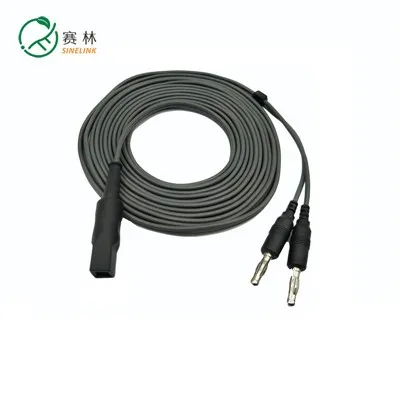
The Slinelink European reusable bipolar cable is applied to connecting European type bipolar forceps and high frequency electrotome and compatible with Aesculap®, Erbe® ICC International, Conmed® ACMI®, Codman®, Olympus®, Valleylab®, US Standard® and so on.

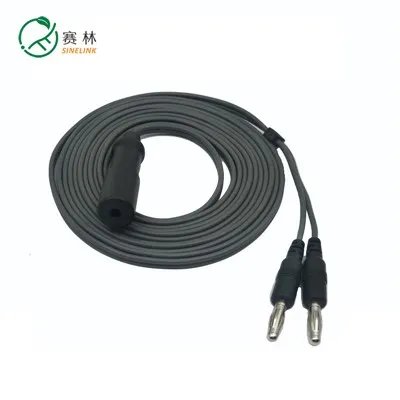
The Slinelink electrosurgical bipolar cable is applied to connecting US type bipolar forceps and high frequency electrotome and compatible with Aesculap®, Erbe® ICC International, Conmed® ACMI®, Codman®, Olympus®, Valleylab®, US Standard® and so on.

Reusable Electrosurgical Bipolar Forceps Cable Aesculap
Reusable electrosurgical bipolar forceps cable Aesculap consists of Aesculap® type connector and 2- Φ4mm banana plug, and the 3m double single-core paralleled wire of silicone material.

Bipolar Cable For R.Wolf Instruments
Bipolar cable for R.Wolf instruments consists of R.Wolf® type connector and 2- Φ4mm banana plug, and the 3m double single-core paralleled wire of silicone material.

Medical Electrosurgery Bipolar Cable For Karl Storz
Karl Storz bipolar cable cord consists of Karl Storz® type connector and 2- Φ4mm banana plug, and the 3m double single-core paralleled wire of silicone material.

Reusable Laparoscopic Instrument Electrosurgical Connector Cable
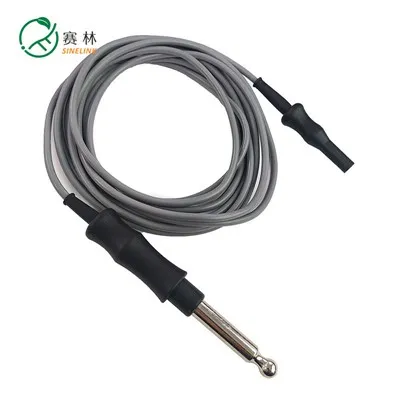
Reusable 8mm to 4mm monopolar cable,it features an 8mm connector on one end and a 4mm connector on the other, ensuring compatibility with various devices and equipment used in surgical procedures.

Reusable Monopolar Laparoscopic Cable
Reusable monopolar laparoscopic cables are an indispensable tool in contemporary laparoscopic surgery.

Monopolar Instrument 4mm To 3mm Cables
Surgeons and medical professionals around the world choose these cables for their precise design and rugged construction, ensuring reliable performance in the operating room.

Reusable Laparoscopic Bipolar Cable For R.Wolf
The Slinelink bipolar cable is applied to R.Wolf® Instruments for laparoscopic and compatible with Aesculap®, Erbe® ICC International, Conmed® ACMI®, Codman®, Olympus®, Valleylab®, US Standard® and so on.
What is Laparoscopic Monopolar Cable?
In laparoscopic surgery, a monopolar laparoscopic cable is a specialized cable used to transmit electrical energy for cutting or coagulation during surgical procedures. Laparoscopic surgery, also known as minimally invasive surgery, involves making small incisions and using a camera (laparoscope) to visualize the internal organs.
The reusable electrosurgical generator cord is designed to deliver current from the electrosurgical generator unit to electrosurgical devices via a monopolar cord during endoscopic procedures. One end of the electrosurgical cord attaches to the monopolar accessory and the other end of the monopolar cable attaches to the monopolar electrosurgery generator port.
types of CNC machining
Transmission of Electrical Energy:
The monopolar laparoscopic cable serves as the conduit for the transmission of electrical energy from the electrosurgical generator to the laparoscopic instrument, allowing the surgeon to perform cutting or coagulation procedures.
Instrument Compatibility:
These cables are designed to be compatible with various laparoscopic instruments, including scissors, graspers, or electrodes, which are used for different surgical tasks.
Insulation and Durability:
The cable is constructed with materials that provide insulation and durability, ensuring safe and reliable transmission of electrical energy during surgery.
Connector Types:
Monopolar laparoscopic cables typically have specific connectors at each end to ensure proper connection between the cable, the laparoscopic instrument, and the electrosurgical generator.
Safety Measures:
During laparoscopic surgery, safety measures are essential. Surgeons need to be aware of the potential risks associated with electrosurgery, and proper training is required to use these instruments safely.
Electrosurgery makes use of high-frequency electrical current to cut, coagulate, desiccate, and fulgurate tissue and can be performed using either monopolar or bipolar-energy in conjunction with a specialized instrument. Each of these two modalities has specific advantages and understanding the difference between the two can help you understand the differences in how they're used.
The simplest explanation of the differences between these two methods is that with monopolar electrosurgery, the current passes from the probe electrode, to the tissue and through the patient to a return pad to complete the electric current circuit. In bipolar electrosurgery, the current only passes through the tissue between the two arms of the forceps shaped electrode.
Bipolar electrosurgery
Bipolar electrosurgery uses lower voltages so less energy is required. But, because it has limited ability to cut and coagulate large bleeding areas, it is more ideally used for those procedures where tissues can be easily grabbed on both sides by the forceps electrode. Electrosurgical current in the patient is restricted to just the tissue between the arms of the forceps electrode. This gives better control over the area being targeted, and helps prevent damage to other sensitive tissues. With bipolar electrosurgery, the risk of patient burns is reduced significantly.In the most common techniques, the surgeon uses forceps that are connected to the electrosurgical generator. The current moves through the tissue that is held between the forceps. Because the path of the electrical current is confined to the tissue between the two electrodes, it can be used in patients with implanted devices to prevent electrical current passing through the device causing a short-circuit or misfire. It is always recommended to review the implanted device user manual prior to preforming any electrosurgical application, to avoid complications.
Monopolar Electrosurgery
Monopolar electrosurgery can be used for several modalities including cut, blend, desiccation, and fulguration. Using a pencil instrument, the active electrode is placed in the entry site and can be used to cut tissue and coagulate bleeding. The return electrode pad is attached to the patient, so the electrical current flows from the generator to the electrode through the target tissue, to the patient return pad and back to the generator. Monopolar electrosurgery is the most commonly used because of its versatility and effectiveness.
How Does Laparoscopic Monopolar Cable Work?
An electrosurgical system consists of an electrosurgical unit, sometimes referred to as a generator or an ESU. The active electrode, the patient, and (as needed) the dispersive electrode sometimes referred to as the grounding pad. The generator takes current from the outlet and speeds it up. At this frequency, muscles and nerves are not affected, and heat is created at the cellular level.2 The heat created is responsible for the cutting and coagulation effect that is experienced.
Laparoscopic Monopolar Cable works by cutting or coagulating tissue via a high-frequency electrical current that is generated from an electrosurgical unit or ESU. The electrical current travels through an attached device (active electrode) and creates localized heating to allow for precise cuts or coagulation of the tissue which helps to reduce the risk of bleeding. By adjusting the method, mode, and power settings (wattage), physicians can customize the unit output setting for a variety of procedures.

How to Sterilize Laparoscopic Monopolar Cable?
Autoclaving by means of steam was the oldest, safest, and most cost-effective method of sterilization. When steam is placed under pressure and the temperature is raised, the moist heat produces changes within the cell protein, thereby rendering it harmless over a prescribed period of time. The relationship between temperature, pressure, and time of exposure is the critical factor in the destruction of microbes. Although steam sterilization ineffective an inexpensive it is not suitable for all Laparoscopic Monopolar Cable.
The growth and expansion of minimal access surgical procedures require specialized surgical instrumentation. Most of the Laparoscopic Monopolar Cable can be safely autoclaved but some of the Laparoscopic Monopolar Cable cannot withstand the prolonged heat and moisture of the steam sterilization process. Laparoscopic cameras, laparoscopes, light cables, and flexible endoscopes are damaged by heat. Therefore, alternative methods of sterilization were needed to effectively sterilize moisture-stable, moisture-sensitive, and heat-sensitive items that require rapid, frequent processing in the clinical setting.
One of the most common types of alternative of steam sterilization is chemical sterilization. Many chemicals are proven to have sterilizing properties. Laparoscopic camera (CCD) is damaged by chemical sterilization with repeated exposure. In these expensive devices, a sterile plastic sleeve or sterile thick cloth sleeve should be used to avoid contamination.
Application of Laparoscopic Monopolar Cable
A Laparoscopic Monopolar Cable is an electronic device used in surgery that can provide high-frequency current for cutting, coagulating and welding tissue. Disposable laparoscopic high-frequency surgical electrodes are one of the applications.
Laparoscopic surgery is a minimally invasive surgery performed by inserting a Laparoscopic Monopolar Cable through a small incision. In this surgery, doctors need to use an electric knife to cut and coagulate tissue to complete the surgical operation. Disposable laparoscopic high-frequency surgical electrodes are designed to meet this demand.
This surgical electrode is usually made of conductive material with good conductivity and high temperature resistance. It can be connected to a high-frequency power supply to achieve the function of cutting and coagulating tissue through high-frequency current. Since it is disposable, the risk of cross infection can be avoided and the safety of the operation can be improved.
Disposable Laparoscopic Monopolar Cable electrodes are widely used in clinical practice. It can be used for various laparoscopic surgeries, such as cholecystectomy, appendectomy, hysterectomy, etc. In these operations, doctors can choose electrodes of different shapes and sizes as needed to meet the requirements of surgical operations.
The use of disposable electrodes can also reduce the number of operating steps during the operation and improve surgical efficiency.
The doctor only needs to connect the electrode to the high-frequency power supply and then perform the surgical operation without the need for cleaning and disinfection. This not only saves time, but also reduces human errors during the operation.
The disposable Laparoscopic Monopolar Cable surgical electrode is a commonly used instrument in laparoscopic surgery. It has good conductivity and high temperature resistance, and can complete the surgical operation safely and efficiently. In clinical practice, it is widely used in various laparoscopic surgeries to provide patients with safer and more effective treatment.
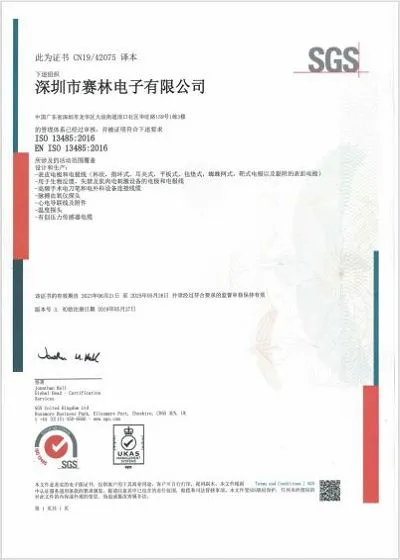
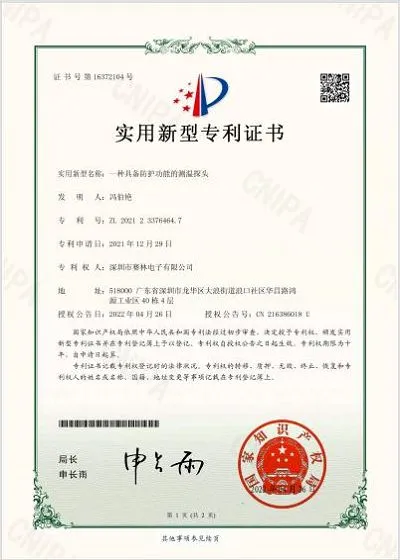
Certificates


FAQ
Hot Tags: laparoscopic monopolar cable, China laparoscopic monopolar cable manufacturers, suppliers, factory, electrosurgical forceps cable, medical electrosurgery bipolar cable for karl storz, electrosurgical bipolar cable, r wolf reusable bipolar cable, european reusable bipolar cable, bipolar cable for r wolf instruments